
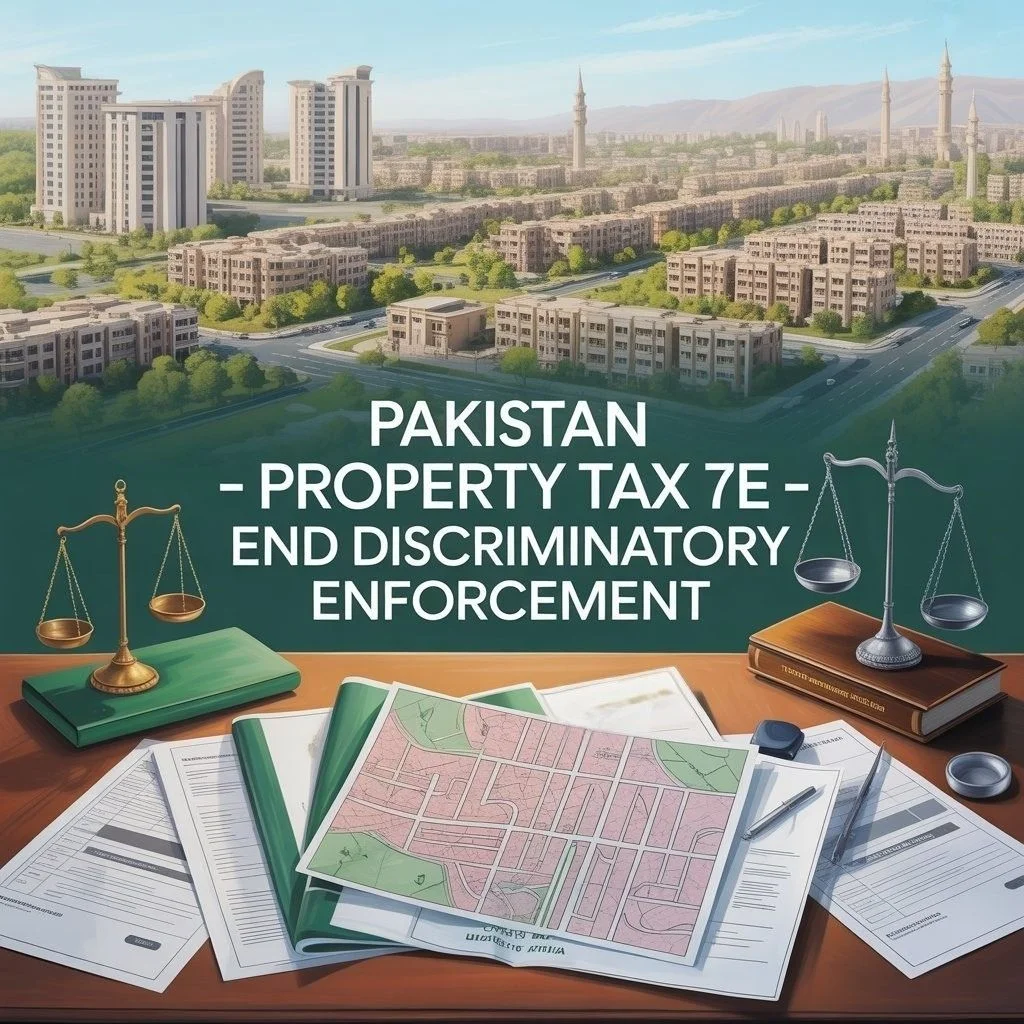
Recent developments in Pakistan’s property tax system have sparked debates among taxpayers, legal experts, and real estate investors. The focus is on Section 7E of the Income Tax Ordinance, 2001, which imposes a tax on deemed income from immovable properties. The Pakistan Tax Bar Association (PTBA) has formally demanded that the Federal Board of Revenue (FBR) end what it calls discriminatory enforcement of this tax, raising concerns about fairness and transparency in tax administration.
Understanding Section 7E
Section 7E tax was introduced through the Finance Act of 2022 to broaden Pakistan’s tax base by taxing the fair market value of immovable properties. The law treats the value of a property as income, effectively creating a tax liability even without an actual cash transaction. This approach is unique because it taxes property ownership rather than property sale, making it a critical consideration for property owners and real estate investors.
The tax rate under Section 7E is calculated based on the deemed income derived from the property. This type of immovable property tax has been controversial, with legal challenges questioning its alignment with Pakistan’s constitution and its impact on taxpayers in different provinces.
Why PTBA is Raising Concerns
The PTBA has highlighted a troubling pattern notices under Section 7E are primarily being issued in Punjab and Sindh. While other provinces, including Khyber Pakhtunkhwa (KPK) and Balochistan, have largely avoided enforcement. This selective implementation has been termed discriminatory by the PTBA, as it treats taxpayers unequally across regions.
Thousands of property owners have reportedly received notices demanding compliance with Section 7E. While residents in other provinces have faced no such action. According to PTBA, this uneven enforcement undermines confidence in the FBR and the broader tax system. As it creates a perception of unfair treatment among taxpayers.
Legal Challenges to Section 7E
Since its introduction, Section 7E has faced multiple legal challenges in various high courts. Property owners argue that taxing deemed income from ownership of immovable property exceeds the legal authority of federal taxation and violates constitutional principles. Several high courts, including those in Sindh, Islamabad, and Peshawar, have ruled parts of Section 7E as ultra vires, effectively preventing enforcement in their respective jurisdictions.
Despite these rulings, enforcement continues in some regions, creating uncertainty for property owners. Appeals are ongoing in higher courts, leaving the legal status of Section 7E unresolved in several provinces. This inconsistency has heightened calls for a uniform and equitable approach to property taxation.
Impact on Property Owners and Real Estate

The enforcement of Section 7E directly affects property owners and the real estate market in Pakistan. Many owners in Punjab and Sindh are compelled to comply with tax notices or face penalties, while others in different regions are unaffected. This disparity has led to uncertainty in the property market, influencing decisions regarding buying, selling, or holding immovable assets.
Property taxes under Section 7E also influence investment decisions. Real estate investors are concerned that selective enforcement may reduce confidence in the market and hinder future investments. Business groups have highlighted that inconsistent application of property taxes could discourage investment and dampen economic growth in a sector critical to Pakistan’s economy.
Unequal Enforcement Across Provinces
One of PTBA’s main concerns is the geographical disparity in enforcement. Notices are predominantly issued in Punjab and Sindh, while other provinces benefit from temporary court protections or lack of active enforcement. PTBA argues that a nationwide tax law should apply uniformly to all provinces to ensure fairness and legal consistency.
Selective enforcement raises constitutional questions, particularly regarding equality before the law. Taxpayers facing notices in certain regions feel disadvantaged, especially when courts in other areas have restrained similar actions. This inequality has become a central point in PTBA’s advocacy for reform and equitable application of Section 7E.
FBR’s Compliance Measure
The FBR has issued guidelines for compliance under Section 7E and related provisions, requiring property owners to declare their immovable assets and pay taxes accordingly. Non-compliance can result in penalties, including restrictions on property transfers.
While these measures aim to enhance tax collection and compliance, property owners argue that valuation methods used by the FBR do not always reflect realistic market prices. This discrepancy contributes to taxpayer frustration and adds to the perception of unfair enforcement.
The Debate on Tax Fairness
The debate surrounding Section 7E revolves around two key issues how to broaden the tax base fairly and how to enforce tax laws without discriminating among taxpayers. The PTBA insists that while it is legitimate for the government to expand its tax base, enforcement must be transparent, lawful, and consistent.
Property owners, legal experts, and business groups agree that the aim of Section 7E collecting taxes on immovable properties is reasonable. However, selective application undermines trust in the system and could have negative implications for the real estate market. Fair enforcement would ensure equal treatment, reduce litigation, and strengthen confidence in Pakistan’s tax regime.
Implications for Real Estate Investors
For real estate investors, Section 7E enforcement presents both a legal and financial challenge. Investors must now account for potential tax liabilities on their immovable assets, even if no income is generated. Compliance requires accurate valuation and timely payment to avoid notices or penalties.
The uncertainty surrounding enforcement in different provinces complicates investment planning. Investors are increasingly seeking legal guidance to navigate Section 7E, protect their assets, and ensure adherence to tax regulations.
Moving Forward
As of early 2026, the controversy surrounding Section 7E continues. The PTBA’s demands for fair enforcement have reignited discussions about legal consistency, taxpayer rights. And the role of provincial courts in regulating property taxation. Resolving these issues will be critical to maintaining trust in Pakistan’s property tax system and ensuring that FBR enforcement is seen as fair and transparent.
Property owners and real estate professionals are advised to stay informed about legal developments and maintain compliance with reporting and tax obligations. Understanding Section 7E, its implications, and the ongoing legal discourse is essential for anyone involved in the Pakistan real estate market.
Conclusion
The debate over Pakistan property tax Section 7E underscores the challenges of enforcing federal tax laws uniformly across provinces. The PTBA’s call for an end to discriminatory enforcement highlights the need for fairness, legal clarity, and transparency. Proper resolution of these issues will not only affect property owners but also shape investor confidence and the future of the real estate sector in Pakistan.
Want to know more? Check out Plot Registration in Pakistan 2026: Taxes & Fees Guide
Like, share and comment: Facebook, Instagram, Youtube and TikTok.



Join The Discussion