
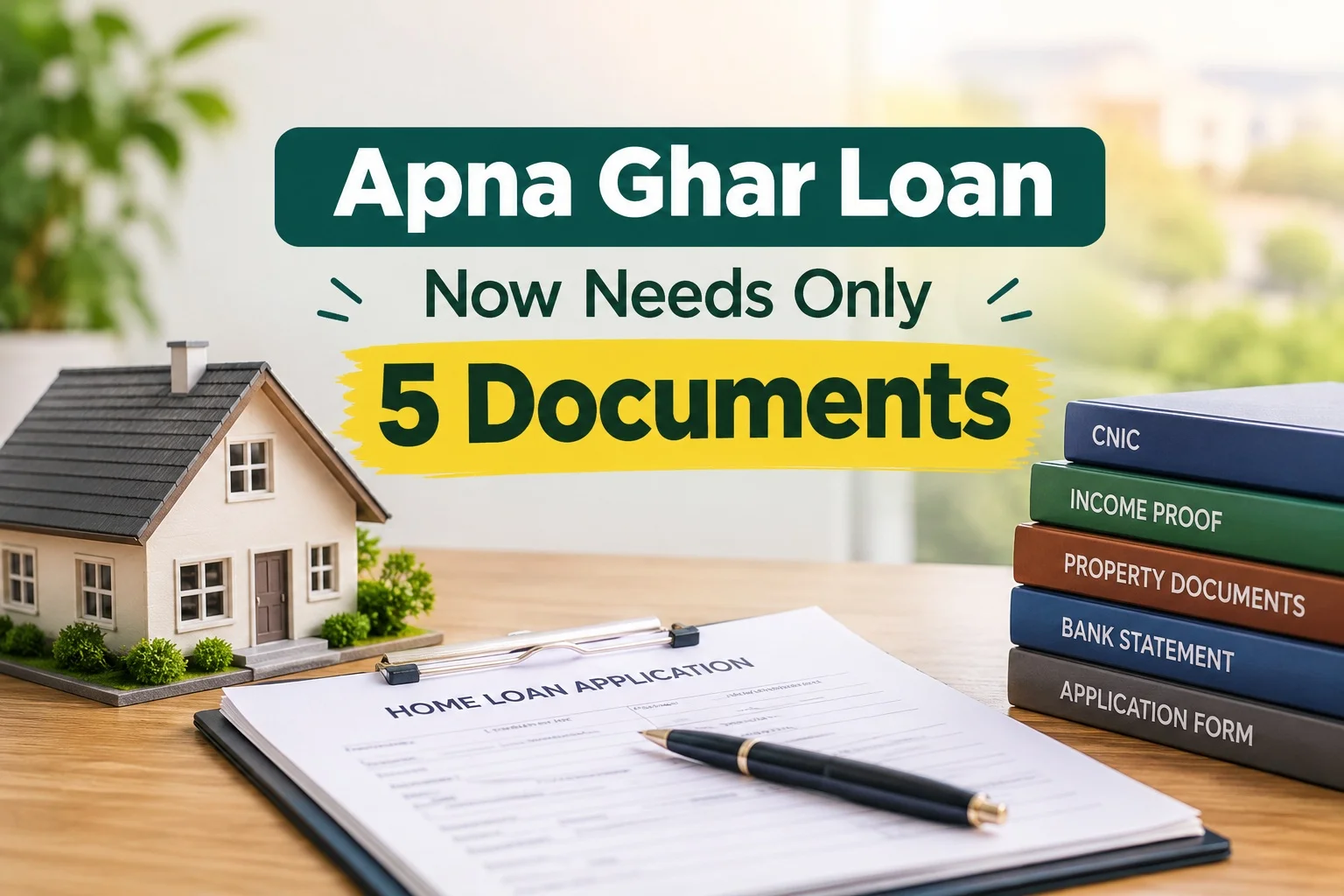
Buying your first home in Pakistan just became easier. In a major update to the Apna Ghar Scheme, the federal government has reduced the property documents banks can demand for a home loan to only five, a move aimed at ending the endless paperwork that has frustrated loan applicants for years.
The Ministry of Housing and Works announced the initiative under the directives of Prime Minister Shehbaz Sharif. The State Bank of Pakistan (SBP) has issued formal instructions to all banks to implement the new standardized documentation rules immediately.
In short: If you’re applying for an Apna Ghar home loan in 2026, your bank can now ask for only five property documents. The transfer letter, possession letter, site plan, mortgage permission letter, and mortgage registration documents. Banks can no longer demand extra title papers, old sale deeds, or additional NOCs beyond the official list.
What Changed in the Latest Update?
For years, one of the biggest complaints from Apna Ghar applicants was not the loan terms which are genuinely attractive but the documentation process. Banks routinely demanded long lists of papers: chains of old sale deeds, extra NOCs, and ancestral ownership records that land offices no longer even issue. Applications stalled, files gathered dust, and many first-time buyers simply gave up.
The Ministry acknowledged these complaints directly. According to its October 19 statement, the documentation has now been reduced to five and fully standardized across all banks, specifically to “provide significant relief” to people seeking housing loans for their first homes.
This is not a minor procedural tweak. For the thousands of applicants currently in the pipeline and the many more considering applying it removes one of the most common reasons home loan applications get delayed or rejected.
The 5 Documents Required for Apna Ghar Home Loan
Here is the complete list of property documents your bank may now require under the Apna Ghar Scheme:
- Transfer Letter — the official document confirming the property has been transferred in your name by the relevant authority or housing society.
- Possession Letter — proof that physical possession of the plot or property has been handed over to you.
- Site Plan — the approved layout or map of your property, showing its dimensions and location.
- Mortgage Permission Letter — written permission from the development authority or society allowing you to mortgage the property to the bank.
- Mortgage Registration Documents — the registered mortgage papers created once the bank secures its charge on the property.
That’s it. If your bank’s checklist includes anything beyond these five property papers for the property/title side of your application it is asking for more than the rules allow.
Important distinction: the five-document limit covers property and title documents only. You will still need to provide personal documents like your CNIC, income proof (salary slips or business records), and bank statements. Which are governed by separate banking regulations.
The Legal Basis: SBP Circular No. 06 of 2026
The announcement followed SBP’s SH&SFD Circular No. 06 of 2026, which amended Regulation HF-7 of the housing finance prudential regulations.
The critical change is in the wording. The old rule said banks could collect “all” title and ownership documents a single word that gave every bank freedom to invent its own additional demands. The new rule replaces that with a fixed list in Annexure B of the circular, titled “Standardized and Simplified Documentation for Housing Finance.”
Annexure B covers 10 property types from urban development authority plots and housing society files to DHA properties, cantonment leases, rural revenue land, and Evacuee Trust properties each with specific requirements for open plots, houses under construction, and completed homes. The listed documents are now the ceiling: what the circular lists is all the bank may ask for.
The same circular also introduced two related reforms worth knowing: banks may now extend solar and renewable-energy finance with no security at all, and for housing loans up to Rs5 million, banks may record a simple lien in the land record instead of requiring a full registered mortgage a cheaper and faster option for smaller loans.
Special Relief for Punjab: The Green Property Certificate

Home buyers in Punjab including Faisalabad get an additional advantage. Housing finance can now be extended against the Green Property Certificate issued by the Punjab government (or equivalent certificates issued by competent authorities in other provinces).
Because this certificate comprehensively verifies title, ownership, and possession in a single document, properties holding one require no additional ancestral, historical, or separate ownership documents. If you own a plot in a Punjab housing society with this certificate, the bank cannot ask you to dig up decades-old ownership chains.
Apna Ghar Scheme: Key Terms at a Glance
| Feature | Details |
| Maximum loan | Up to Rs10 million (Rs1 crore) |
| Markup rate | 5% fixed for the first 10 years, then ~KIBOR + 3% |
| Repayment tenure | Up to 20 years |
| Down payment | 10% (bank finances 90%) |
| Property limit | House up to 10 marla / flat up to 1,500 sq ft |
| Processing fee | None |
| Prepayment penalty | None |
| Eligibility | Pakistani citizen with valid CNIC, first-time homebuyer, minimum income ~Rs40,000/month |
| How to apply | Online at apnaghar.gov.pk or at any participating bank branch / HBFC; helpline 051-111-742-111 |
To put the affordability in perspective: a Rs5 million loan at the 5% fixed rate works out to roughly Rs33,000 per month over 20 years often comparable to rent for a similar property in cities like Faisalabad.
What If Your Bank Still Demands Extra Documents?
The new rules give you clear, enforceable rights. Here’s exactly what to do if a bank asks for papers beyond the official list:
- Ask for the bank’s document checklist in writing, then compare it with the standardized list for your property type.
- Ask which SBP rule the bank is relying on for any extra demand. Under the amended HF-7, it won’t have a valid answer.
- Keep the signed acknowledgement the bank is required to give you for every document you submit.
- Complain first to the bank. If it doesn’t resolve the matter, escalate to SBP’s Sunwai complaint portal, quoting “SH&SFD Circular No. 06 of 2026” so your complaint is routed correctly.
Knowing these steps matters: many applicants don’t realize the bank’s checklist is now legally capped, and simply comply with unreasonable demands out of fear of rejection.
Why This Update Matters Now
The timing is significant. By end-September 2026, Rs76 billion had already been disbursed to 13,214 borrowers under the Apna Ghar Programme. While a further Rs350 billion in approved loans was awaiting disbursement. That is a large pipeline of applicants who will directly benefit from simpler paperwork.
The update also lands alongside the newly launched National Housing Policy 2025 Pakistan’s first national housing policy in nearly 25 years. Which targets the country’s estimated 13-million-unit housing shortfall. The government’s direction is clear: strip away procedural barriers so formal housing finance reaches ordinary families, not just the well-connected.
Frequently Asked Questions (FAQs)
1. Does the 5-document rule mean my whole loan application needs only 5 papers?
No. The limit applies to property and title documents only. Income proof, CNIC, the application form, and credit-history checks follow separate rules and are unchanged.
2. When did the new documentation rules take effect?
The SBP circular took effect on October 9, 2026, and the Ministry’s public announcement followed on October 19, 2026. Both are in force now.
3. I have a Green Property Certificate in Punjab. Do I need old ownership records?
No. With a valid certificate, the bank cannot demand ancestral or historical ownership documents.
4. Can the bank still reject my application?
Yes. Simplified documentation doesn’t change eligibility assessment the bank still evaluates your income, repayment capacity, and credit history before approving the loan.
5. Where can I apply for the Apna Ghar loan?
Through the official portal apnaghar.gov.pk, or in person at branches of participating commercial banks, Islamic banks, microfinance banks, and the House Building Finance Company (HBFC).
Conclusion
The reduction of Apna Ghar home loan documents to just five is the most applicant-friendly change to the scheme since its launch. By replacing the open-ended “all documents” rule with a fixed, standardized list and backing it with a formal SBP circular the government has shifted real power from banks to borrowers.
The scheme already offers up to Rs10 million at a fixed 5% markup for 10 years. It also provides a 20-year repayment period and zero processing fees. For many first-time buyers, paperwork was the last major hurdle. The new rules have significantly reduced this barrier.
If you’ve been postponing your application because of documentation worries, this is the right time to act: confirm your eligibility, gather the five property documents, and apply through apnaghar.gov.pk or your nearest participating bank branch. And if any bank still asks for more than the rules allow, you now know exactly how to push back.
Want to know more? Check out Apna Ghar Scheme Survey: How Plot Owners Can Get Housing Loans.
Like, share and comment: Facebook, Instagram, Youtube and TikTok.



Join The Discussion