
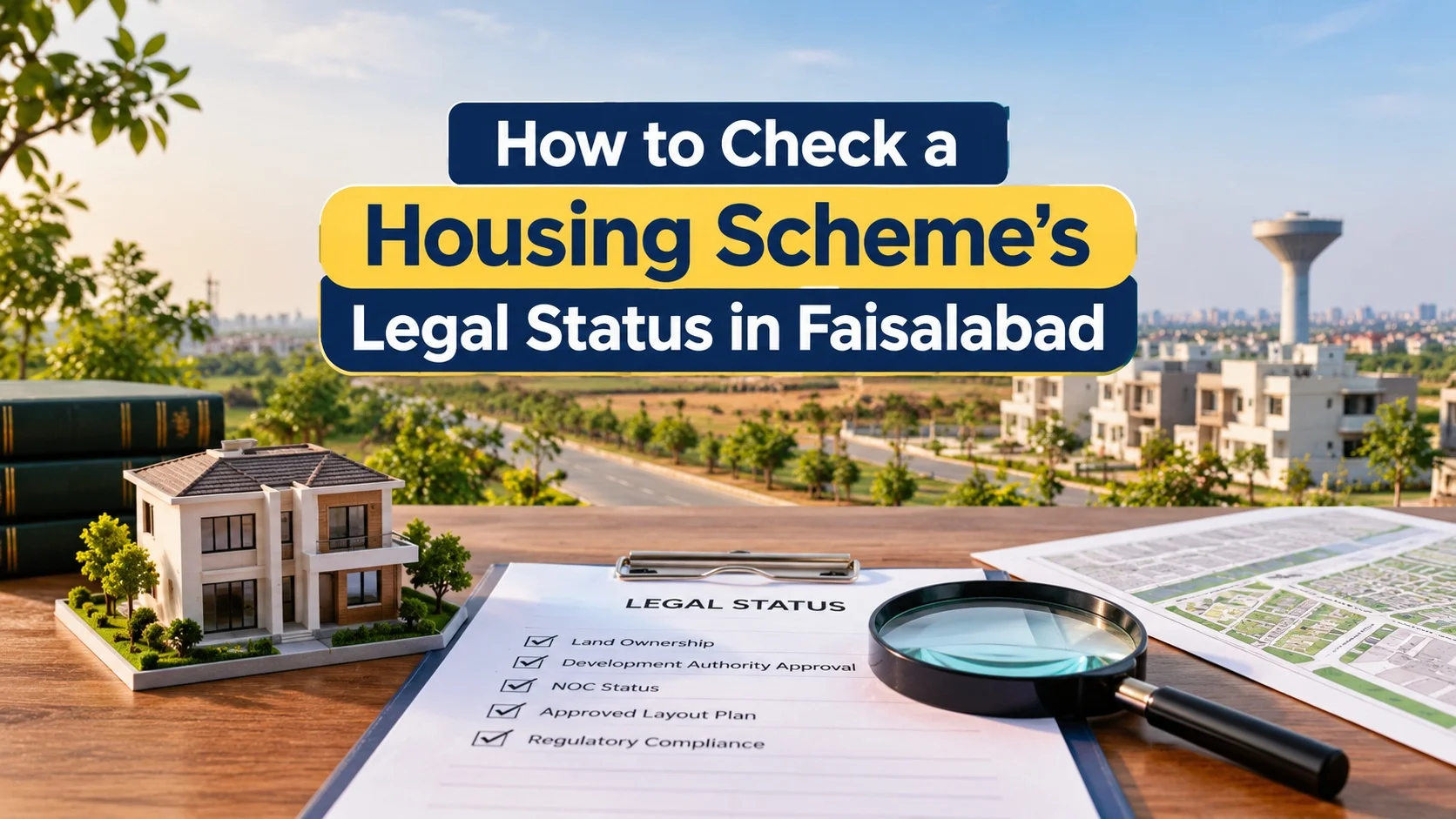
Buying a plot in a housing scheme is a major financial decision, so checking the housing scheme legal status in Faisalabad should come before paying a booking amount or signing any agreement. A scheme may be marketed as approved or secure, but buyers should independently verify its FDA approval, NOC, land records, and development status.
In Faisalabad, buyers can reduce the risk of purchasing property in an unauthorized project by checking the relevant records and comparing the approved information with what the developer is offering. Here is a practical guide on how to check a housing scheme’s legal status in Faisalabad.
1. Check the Housing Scheme’s FDA Approval
The first step is to determine whether the housing scheme has received approval from the relevant development authority. In Faisalabad, the Faisalabad Development Authority (FDA) plays an important role in regulating and approving private housing schemes within its jurisdiction.
Do not rely only on a developer’s brochure, advertisement, social media post, or sales representative. Ask for the official approval details and verify whether the scheme appears in the authority’s available records.
When checking approval, pay attention to:
- Name of the housing scheme
- Developer or sponsor name
- Approved area and boundaries
- Approval or permission details
- Approved layout plan
- Current approval status
A scheme’s name can sometimes be similar to another project, so buyers should make sure the records they are checking relate to the exact project and location they intend to purchase.
2. Verify the NOC and Approval Documents
A No Objection Certificate, commonly known as an NOC, is an important document buyers should investigate before investing in a housing scheme.
However, simply seeing a copy of an NOC does not mean the buyer has completed proper verification. Check whether the document is genuine and whether it corresponds to the actual housing project being marketed.
Ask the developer for relevant approval documents and compare the information with official records where possible.
Buyers should particularly check:
- Scheme name
- Location
- Approved land area
- Developer details
- Approval status
- Conditions attached to the approval
If the seller refuses to provide basic approval information or pressures you to make an immediate payment, consider it a warning sign.
3. Compare the Approved Layout Plan
An approved housing scheme is generally associated with an approved layout plan showing important details such as residential plots, roads, parks, commercial areas, public facilities, and other designated spaces.
Buyers should compare the layout plan provided by the developer with the approved plan.
This is important because the plot being offered may not necessarily correspond to the approved development plan. A particular block, extension, road, or plot category may require separate verification.
Before purchasing, confirm:
- The block exists in the approved plan
- The plot number is identifiable
- The plot category is correct
- Roads and public spaces match the approved plan
- The offered location falls within the approved scheme boundaries
This simple comparison can help identify inconsistencies before money is committed.
4. Verify Land Ownership and Title Records
Approval of a housing scheme does not remove the need to investigate land ownership. Buyers should understand who legally owns the land and whether the developer has the authority to sell plots within the project.
Land records and title documents can help establish ownership and identify potential issues such as disputes, claims, or unclear title.
Depending on the transaction, buyers may need to examine documents such as:
- Ownership records
- Sale deeds
- Registry documents
- Mutation records
- Land title information
- Relevant agreements between landowners and developers
For a significant investment, professional legal advice can be worthwhile, particularly when ownership documents are complicated or multiple parties are involved.
5. Check the Developer’s Credentials
The legal status of the land is only one part of property due diligence. Buyers should also investigate the developer or sponsoring entity behind the housing scheme.
Look at the developer’s previous projects, business information, track record, and ability to complete promised development.
Be cautious if the developer:
- Makes unrealistic investment promises
- Avoids showing approval documents
- Changes project details frequently
- Requests payments without proper documentation
- Offers unusually large discounts for immediate booking
- Cannot clearly explain ownership or approval status
A professional developer should be able to provide clear information about the project and its documentation.
6. Confirm the Actual Development Status
A housing scheme may have approval-related documentation but still be at an early stage of development. Therefore, buyers should not confuse legal approval with completed infrastructure.
Visit the site and check the actual condition of the project.
Look for:
- Roads and streets
- Electricity infrastructure
- Water and drainage arrangements
- Parks and community facilities
- Commercial areas
- Boundary development
- Construction activity
- Accessibility to the location
If the developer promises facilities that are not currently available, ask for a realistic development timeline and supporting documentation.
7. Verify the Plot Before Making Payment
Even if the overall housing scheme appears legitimate, buyers should verify the individual plot before purchasing.
Confirm that the plot number, block, size, location, and ownership details correspond with the documents provided by the seller.
Also check whether there are any outstanding dues, transfer restrictions, mortgages, disputes, or other issues affecting the plot.
Keep copies of all important documents, including:
- Booking form
- Allotment letter
- Payment receipts
- Transfer documents
- Sale agreement
- Possession documents, where applicable
- Developer correspondence
Never depend entirely on verbal promises.
8. Watch for Red Flags
Certain warning signs deserve additional attention when checking the legal status of a housing scheme in Faisalabad.
Be cautious when you encounter:
- “Limited-time” pressure to book immediately
- Missing or unclear approval documents
- Different project names on different documents
- Unclear land ownership
- Plots that cannot be located on an approved plan
- Claims of approval without verifiable evidence
- Promises of guaranteed returns
- Extremely low prices compared with nearby properties
One warning sign does not automatically prove that a project is illegal, but several inconsistencies should encourage buyers to pause and investigate further.
9. Use Independent Verification Before Buying

Property advertisements are designed to attract buyers, while verification is about protecting the buyer’s interests. Therefore, important claims should be checked independently.
Before paying a substantial amount, verify the housing scheme’s approval, NOC, land ownership, layout plan, developer information, and individual plot documents.
For complicated transactions, consulting a qualified property lawyer or relevant professional can provide an additional layer of protection.
Final Checklist for Buyers
Before purchasing a plot in a Faisalabad housing scheme, ask yourself:
- Is the housing scheme officially approved?
- Can its approval be independently verified?
- Is the NOC genuine and applicable to the project?
- Does the approved layout match the scheme being marketed?
- Is the land ownership clear?
- Does the developer have a credible track record?
- Does the individual plot exist in the relevant records?
- Are there any outstanding dues or legal issues?
- Does the actual development match the developer’s claims?
If you cannot obtain clear answers, it is better to delay the purchase than to make a rushed decision.
Frequently Asked Questions (FAQs)
1. How can I check a housing scheme’s legal status in Faisalabad?
You can check a housing scheme’s legal status by verifying its FDA approval, NOC, approved layout plan, land ownership records, and developer details through relevant official records.
2. How do I verify FDA approval of a housing scheme in Faisalabad?
Check the relevant Faisalabad Development Authority (FDA) records and compare the scheme name, location, developer, approved area, and approval details with the documents provided by the developer.
3. How can I check whether a housing scheme has an NOC?
Ask the developer for the NOC details and independently verify whether the document is genuine and applies to the specific housing scheme, location, and approved area you plan to purchase in.
4. Why should buyers check the approved layout plan before buying a plot?
An approved layout plan helps buyers confirm that the block, plot, roads, parks, commercial areas, and other features being offered are included in the authorized development plan.
5. What should I verify before buying a plot in a Faisalabad housing scheme?
Verify the scheme’s approval, NOC, land ownership, approved layout, developer credentials, plot number, size, location, outstanding dues, and transfer documents before making a significant payment.
Conclusion
Checking a housing scheme’s legal status in Faisalabad requires more than looking at an advertisement or accepting a developer’s claims. Buyers should verify FDA approval, examine the NOC, compare the approved layout plan, investigate land ownership, assess the developer, and confirm the status of the individual plot.
The safest approach is to treat property verification as a step-by-step process. Taking time to check the documents and project details before investing can help buyers identify potential problems and make a more informed property decision.
Want to know more? Check out Punjab Housing Society Verification System: How Buyers Can Check Legal Status.
Like, share and comment: Facebook, Instagram, Youtube and TikTok.




Join The Discussion