
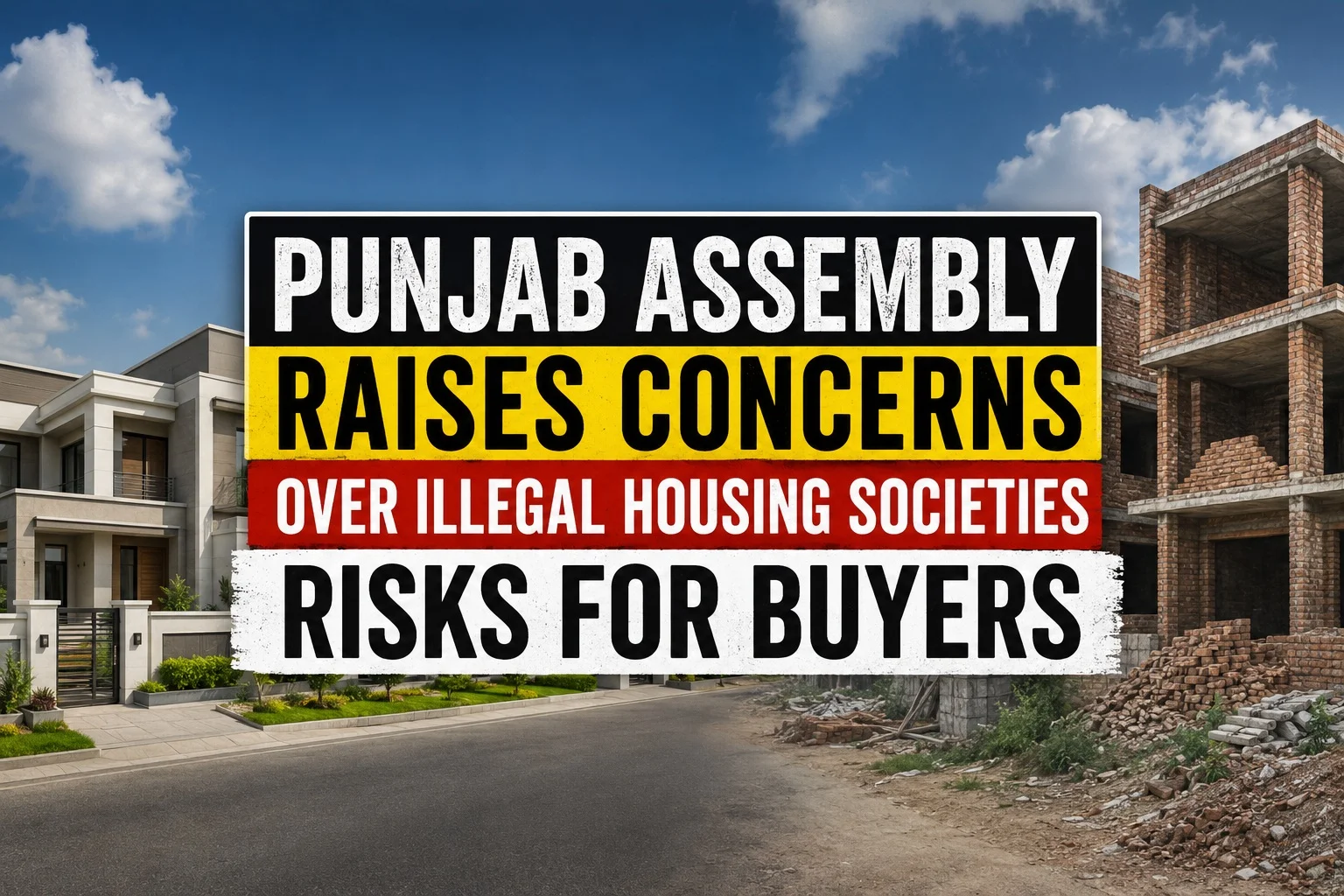
The Punjab Assembly has raised concerns over illegal housing societies allegedly leaving citizens at risk of losing their hard-earned savings. The issue was raised during the Assembly’s Zero Hour after opposition member Ahmer Rashid Bhatti highlighted complaints about housing schemes that had reportedly collected money from citizens but failed to provide promised facilities or return their investments.
The Assembly directed the provincial Housing Department to provide a prompt response. Speaker Malik Muhammad Ahmad Khan also expressed concern over citizens’ lifetime savings and suggested that further parliamentary intervention could be considered if the matter was not resolved through the relevant department or courts.
The development is significant for property buyers across Punjab because it highlights the financial and legal risks that can arise when people invest in housing schemes without properly checking their approval status, land ownership and development permissions.
What Happened in the Punjab Assembly?
The issue of illegal housing schemes was raised by MPA Ahmer Rashid Bhatti during Zero Hour. According to the report, he told the House that several housing schemes had collected money from citizens but allegedly failed to deliver promised facilities or return their investments.
Parliamentary Secretary for Housing Sultan Bajwa informed the Assembly that a case involving the relevant society was pending before the National Accountability Bureau (NAB).
The Speaker directed the Housing Department to submit an early response and suggested that the NAB regional director could be summoned to brief the House about action being taken against illegal housing societies.
The Speaker further indicated that if the issue could not be resolved through the courts or relevant department, the Assembly could consider forming a parliamentary committee to take the matter forward.
For buyers, the key takeaway is simple: property verification should come before payment.
Why Are Illegal Housing Societies Risky for Buyers?
Investing in a residential plot can involve a substantial portion of a family’s savings. When a housing scheme operates without the required approvals or sells plots outside its approved area, buyers may face significant problems.
Some potential risks include:
- Loss of invested money
- Delayed or denied plot possession
- Incomplete roads and infrastructure
- Lack of promised utilities and facilities
- Land ownership disputes
- Problems transferring or reselling a plot
- Legal complications
- Uncertainty about future development
A low plot price or an attractive payment plan does not necessarily make a project a safe investment. Buyers should assess the legal status of the housing scheme before considering its price or potential future value.
How to Check Whether a Housing Society Is Approved
One of the most important steps in avoiding illegal housing societies in Punjab is checking the project’s legal status through the relevant government authority.
Punjab maintains official information related to housing schemes, while local development authorities may also publish details about approved, illegal or unauthorized schemes.
Buyers should determine:
- Which authority has jurisdiction over the housing scheme.
- Whether the project has received the required approval.
- Whether its NOC is valid and applicable to the project being marketed.
- Whether the approved layout plan covers the block being sold.
- Whether the developer is selling plots within the approved scheme boundaries.
Punjab’s Local Government and Community Development Department also lists the Punjab Private Housing Schemes Rules, 2022, along with amendments, providing a regulatory framework relevant to private housing schemes.
Why NOC Verification Matters
A housing society’s NOC (No Objection Certificate) is an important part of property due diligence, but buyers should not simply accept a photocopy or screenshot provided by a dealer.
The document should be independently verified with the relevant authority.
Buyers should also check whether the NOC or approval relates to the specific project, block or area being offered to them.
This distinction matters because a developer may have approval for a particular area while separately marketing an extension or additional block. Buyers should therefore compare the actual plot location with the approved layout plan rather than relying solely on verbal assurances.
Recent enforcement activity also shows why this check is important. The Rawalpindi Development Authority recently issued notices to 13 housing schemes and warned investors to verify approval status before investing. The authority said some schemes were allegedly violating relevant laws and rules and directed sponsors to stop development, advertising and plot transactions.
Land Ownership Verification Is Equally Important
Checking housing society approval is only one part of the process. Land ownership verification is also essential.
A buyer should determine whether the land being offered actually belongs to the relevant owner or developer and whether it can legally be transferred.
Before purchasing a plot, buyers should review:
- Ownership records
- Seller’s authority to sell
- Land boundaries
- Approved scheme area
- Plot number and dimensions
- Relevant development approvals
- Existing disputes, mortgages or restrictions
Housing-scheme approval and individual plot ownership are separate issues. A project may have some form of regulatory approval, but buyers should still verify the ownership and legal status of the particular plot they intend to purchase.
Don’t Rely Only on Property Advertisements
Property advertisements often highlight location, development potential, low prices, installment plans and future facilities. However, marketing claims should not be treated as proof of legal approval.
Buyers should be cautious about claims such as:
- “Approved housing society”
- “NOC approved”
- “Guaranteed return”
- “Future commercial area”
- “Prime investment opportunity”
- “Possession soon”
Instead of relying on promotional material, buyers should ask for documentary evidence and verify it independently.
This is especially important as authorities have warned about the promotion of allegedly unapproved housing schemes through social media, WhatsApp, YouTube and other online platforms.
6 Checks Buyers Should Complete Before Booking a Plot
Before paying a booking amount or signing an agreement, buyers can follow this simple checklist.
1. Check Legal Status
Find out whether the housing scheme is approved, illegal, unapproved, under process or cancelled by the relevant authority.
2. Verify the NOC
Confirm the NOC directly through the competent authority instead of relying only on documents supplied by a seller.
3. Check the Approved Layout Plan
Make sure the block, street and plot being sold are covered by the approved layout plan.
4. Verify Land Ownership
Check the ownership of the underlying land and confirm that the seller has the legal authority to transfer the plot.
5. Review All Charges
Understand the complete cost, including development charges, transfer fees, possession charges and other applicable payments.
6. Keep Transaction Records
Maintain copies of the booking form, receipts, allotment letter, agreement, payment records and correspondence with the developer or seller.
These steps cannot eliminate every property risk, but they can help buyers identify major warning signs before committing their savings.
What the Punjab Assembly’s Concerns Mean for Property Investors
The latest Assembly discussion reinforces an important lesson for property investors: legal verification should be treated as part of investment analysis, not as an optional step.
Investors often focus on location, expected appreciation, development progress and payment plans. These factors matter, but they cannot compensate for uncertainty about a project’s legal status.
A plot with an attractive price may become difficult to sell if the housing scheme faces regulatory action. Similarly, promised infrastructure may remain incomplete if development work is stopped because of approval or legal issues.
For this reason, buyers should evaluate both the investment potential and legal position of a housing scheme before making a decision.
What Should Buyers Do If They Suspect a Housing Scheme Is Illegal?

Anyone who suspects that a housing scheme is operating without proper approval should avoid making additional payments until the project’s legal status is clarified.
Buyers should collect relevant documents, payment receipts and correspondence and contact the appropriate development or local government authority for verification.
Where significant money or a legal dispute is involved, consulting a qualified property lawyer can also help determine the available legal options.
Most importantly, buyers should not assume that other people’s investments, advertising campaigns or the existence of developed roads automatically prove that a scheme is legally approved.
Frequently Asked Questions (FAQs)
1. What are the risks of investing in illegal housing societies in Punjab?
Buyers may face financial losses, delayed possession, incomplete development, legal disputes, land ownership problems and difficulty transferring or reselling their plots.
2. How can I check whether a housing society is approved in Punjab?
Buyers should check the relevant government or development authority’s records and independently verify the project’s approval status before making a payment.
3. Why should buyers verify a housing society’s NOC?
An NOC or relevant approval indicates regulatory clearance from the competent authority. Buyers should verify that the document is genuine and applies to the specific project or area being sold.
4. Can an approved housing society have an unapproved block?
An approval may not automatically cover every extension, block or additional area marketed by a developer. Buyers should compare the property being offered with the approved layout plan.
5. What should I verify before buying a plot in a housing society?
Check the society’s legal status, NOC, approved layout plan, land ownership, plot details, applicable charges and seller’s authority to sell.
6. Is visiting a housing society enough to confirm that it is legal?
No. Roads, houses, offices and other development may show that activity is taking place, but they do not by themselves prove that the housing scheme or specific block has all required approvals.
Conclusion
The Punjab Assembly’s recent concerns over illegal housing societies have once again drawn attention to the risks faced by property buyers. The issue raised in the Assembly involved allegations that citizens had paid money to housing schemes but did not receive promised facilities or refunds, prompting the House to seek a response from the Housing Department.
For buyers, the safest approach is to carry out proper housing society verification before investing. Check the project’s approval status, NOC, approved layout plan and land ownership, and verify the documents through the relevant authority.
In Punjab’s property market, a convincing advertisement or attractive price should never replace legal due diligence. Before buying a plot, verify first and pay later.
Want to know more? Check out Punjab Housing Scheme Reforms 2026: What Property Buyers Need to Know.
Like, share and comment: Facebook, Instagram, Youtube and TikTok.




Join The Discussion