
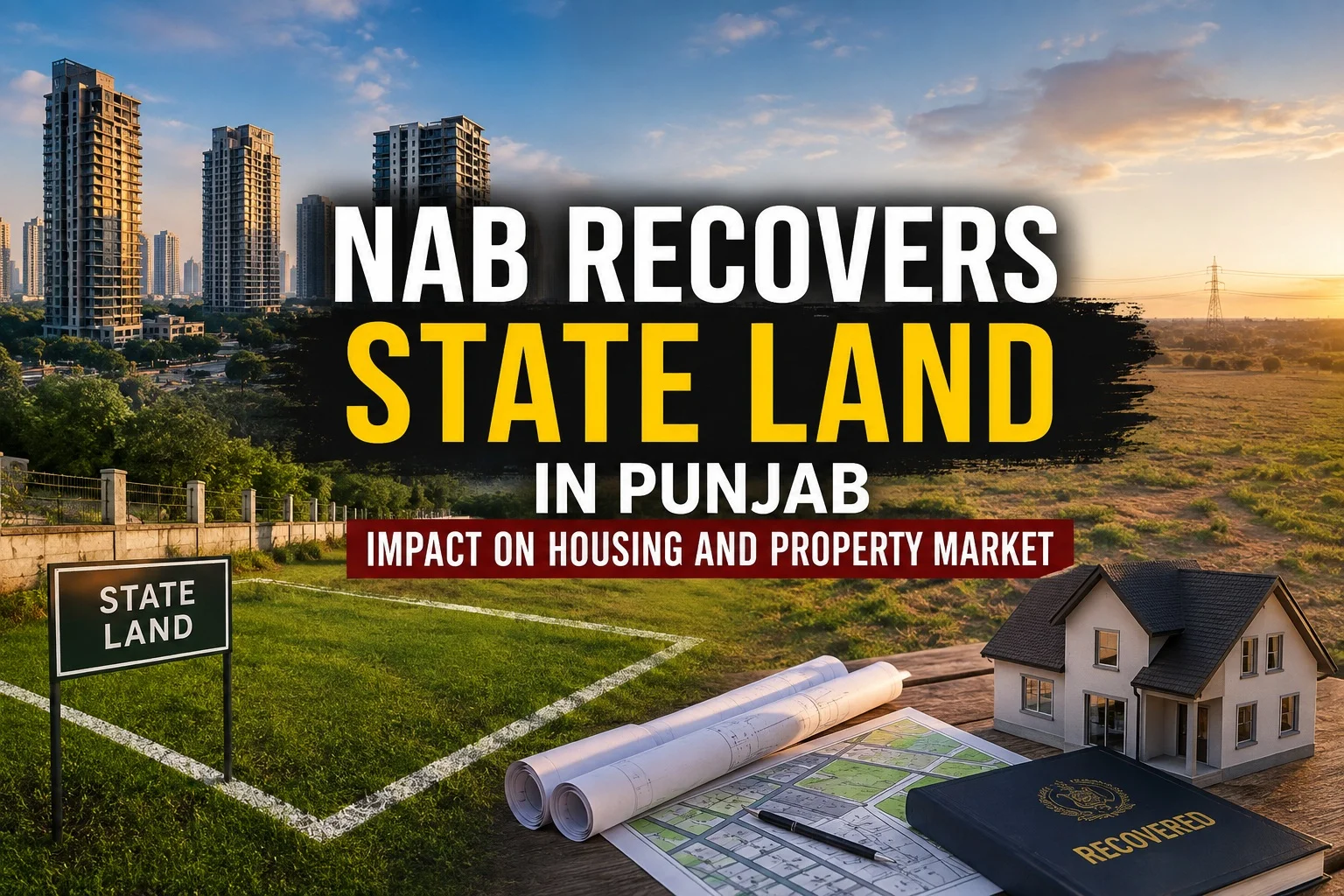
The National Accountability Bureau (NAB) has reported a major recovery of state land in Punjab as part of a wider nationwide drive against illegal occupation and misuse of public assets. The latest figures released in August 2026 show that NAB recovered 1,909 acres of land worth Rs288.29 billion through NAB Lahore, while NAB Multan recovered another 920 acres valued at Rs2.76 billion.
The development is important for Punjab’s real estate sector because government land recovery can affect land management, urban planning, housing development and investor confidence. However, the recovered land should not automatically be viewed as new land available for private housing projects. Its future use will depend on ownership, legal status, planning requirements and government decisions.
What Did NAB Recover in Punjab?
According to NAB’s second-quarter 2026 performance report, the bureau recovered more than 1,078,283 acres of state land across Punjab, Sindh, Balochistan and Islamabad Capital Territory during the quarter. Overall recoveries reached approximately Rs2.45 trillion in Q2 2026, taking NAB’s first-half recovery figure to about Rs5.41 trillion.
Punjab accounted for significant land recoveries. NAB Lahore recovered 1,909 acres valued at Rs288.29 billion, including land related to the Punjab Cooperative Board for Liquidation and other state land. NAB Multan separately recovered 920 acres worth Rs2.76 billion.
These figures follow an earlier Punjab recovery operation announced in June, when NAB Lahore and the Punjab Board of Revenue said they had retrieved 25,444 kanals of land worth Rs433 billion from illegal occupation. Officials said the operation involved field enforcement, revenue-record verification, demarcation and coordination with district administrations.
Why Is State Land Recovery Important for Punjab?
State land is a public asset. When it is illegally occupied, improperly allotted or subject to disputed claims, the government can lose control over valuable land that could otherwise be managed for public purposes.
Recovering such property can improve government land management and strengthen the enforcement of ownership records. It can also help authorities identify land that may be required for public infrastructure, urban facilities, environmental protection or other approved development.
For the property market, the biggest potential benefit is not necessarily an immediate increase in housing supply. Instead, stronger control over public land can create a more transparent environment in which developers and buyers can distinguish between legally available land and disputed or illegally occupied property.
Could Recovered Land Increase Housing Supply?
Potentially, but not automatically.
Recovered state land does not immediately become residential or commercial development land. Before any development takes place, authorities would need to establish clear ownership, conduct land-use planning, assess infrastructure requirements and obtain the necessary approvals.
Some land may also have restrictions that prevent residential construction. For example, land reserved for public facilities, forests, roads, irrigation infrastructure or other government purposes may need to remain dedicated to those uses.
Therefore, the direct impact on the housing market will depend on how Punjab authorities ultimately use the recovered land.
If suitable government-owned land is allocated for planned housing or public infrastructure, it could support long-term urban development. If the land is reserved for public services or other purposes, its effect on private housing supply could be limited.
Impact on Punjab’s Property Market
The recovery operation could have several indirect effects on the Punjab property market.
1. Greater focus on legal ownership
Property buyers may become more aware of the importance of checking ownership records before purchasing land. The recovery of disputed and illegally occupied state property highlights the risks associated with relying only on verbal claims or informal documentation.
Buyers should verify the seller’s ownership, property records, land status and relevant approvals before making a transaction.
2. Pressure on illegal land occupation
Stronger enforcement can make it more difficult for individuals or groups to profit from illegally occupied government land. This could support a healthier real estate market by encouraging transactions involving properly documented properties.
3. Better land-use planning
Recovering public land gives authorities greater control over strategic land resources. In the long term, this could support better planning for roads, public facilities, housing and other urban infrastructure.
4. Possible investor confidence boost
Transparent enforcement can improve confidence among property investors. When ownership disputes and illegal occupation are addressed, investors may have greater confidence in formal property transactions.
However, investor sentiment will also depend on the speed and transparency of future land administration and development decisions.
What Does This Mean for Housing Societies?
The NAB recovery figures also have relevance for housing societies.
In its Q2 reporting, NAB Karachi said it recovered 11,422 acres of allegedly illegally allotted state land worth Rs467.11 billion and examined leases involving housing societies and private individuals. Although this particular recovery was in Sindh rather than Punjab, it demonstrates the wider accountability focus on land connected with housing development.
For buyers in Punjab, the message is straightforward: a housing society’s location or marketing claims should not be enough to establish that a project is safe.
Before investing, buyers should check the society’s approval status, approved layout plan, land ownership and relevant No Objection Certificate (NOC). NAB officials have previously advised citizens to verify these details before investing in housing societies or real estate projects.
Will Property Prices Fall Because of the Land Recovery?
There is no evidence that the latest NAB recovery has caused a broad decline in Punjab property prices.
Land recovery alone does not determine property prices. Prices are influenced by location, infrastructure, demand, development activity, financing conditions, taxation, construction costs and investor sentiment.
If recovered land is eventually used for well-planned housing schemes, it could increase the supply of residential plots or homes in selected areas. Greater supply could help moderate prices in specific locations, but that would depend on the scale, timing and nature of development.
What Should Property Buyers Do?
The latest developments reinforce the importance of due diligence.
Before buying a plot, house or property in a housing society, buyers should:
- Verify the seller’s ownership documents.
- Check official land records.
- Confirm the property’s exact location and boundaries.
- Verify the housing society’s approval and NOC.
- Review the approved layout plan.
- Check for mortgages, disputes, claims or encumbrances.
- Avoid relying solely on advertisements or verbal promises.
- Physically inspect the property before completing the transaction.
These steps can reduce the risk of purchasing disputed or improperly documented property.
What Happens Next?
The most important question is how the recovered state land will be managed. The government could retain some land for public purposes, while other parcels may potentially be considered for infrastructure or development where legally and technically appropriate.
For Punjab’s housing and property market, the long-term impact will therefore depend less on the headline recovery figure and more on transparent land management, accurate records, proper planning and lawful development.
Frequently Asked Questions (FAQs)
1. How much state land did NAB recover in Punjab?
NAB reported recovering 1,909 acres worth Rs288.29 billion through NAB Lahore and another 920 acres worth Rs2.76 billion through NAB Multan during the second quarter of 2026.
2. Will NAB’s state land recovery affect property prices in Punjab?
The recovery could influence property prices in selected areas if suitable land is later used for housing or infrastructure. However, property prices also depend on demand, location, development and economic conditions.
3. Will the recovered state land be used for housing development?
Not necessarily. Recovered state land may be reserved for public infrastructure or other government purposes. Any housing development would depend on land-use planning, legal status and government approval.
4. What does NAB’s land recovery mean for Punjab’s property market?
It could strengthen land governance, discourage illegal occupation and improve confidence in properly documented property transactions. Its long-term effect will depend on how the recovered land is managed.
5. What should property buyers check before investing in Punjab housing societies?
Buyers should verify land ownership, the society’s approval or NOC, approved layout plan, property records, boundaries and any disputes or encumbrances before making an investment.
Conclusion
NAB’s latest land-recovery figures highlight the growing focus on protecting state property in Punjab and across Pakistan. With NAB Lahore reporting the recovery of 1,909 acres worth Rs288.29 billion and NAB Multan recovering 920 acres worth Rs2.76 billion, the scale of the operation is significant.
For the housing and property market, the development could support better land governance, discourage illegal occupation and strengthen investor awareness. However, recovered land will not automatically become housing land. Its impact on property prices, housing supply and development will depend on future government planning and lawful utilisation.
For property buyers, the clearest takeaway is simple: verify ownership, approvals and land status before investing. As Punjab strengthens its approach to state land management, proper documentation and due diligence will become increasingly important in the real estate market.
Want to know more? Check out Punjab Property Transfer Desk in London: Services, Benefits & Process.
Like, share and comment: Facebook, Instagram, Youtube and TikTok.




Join The Discussion