
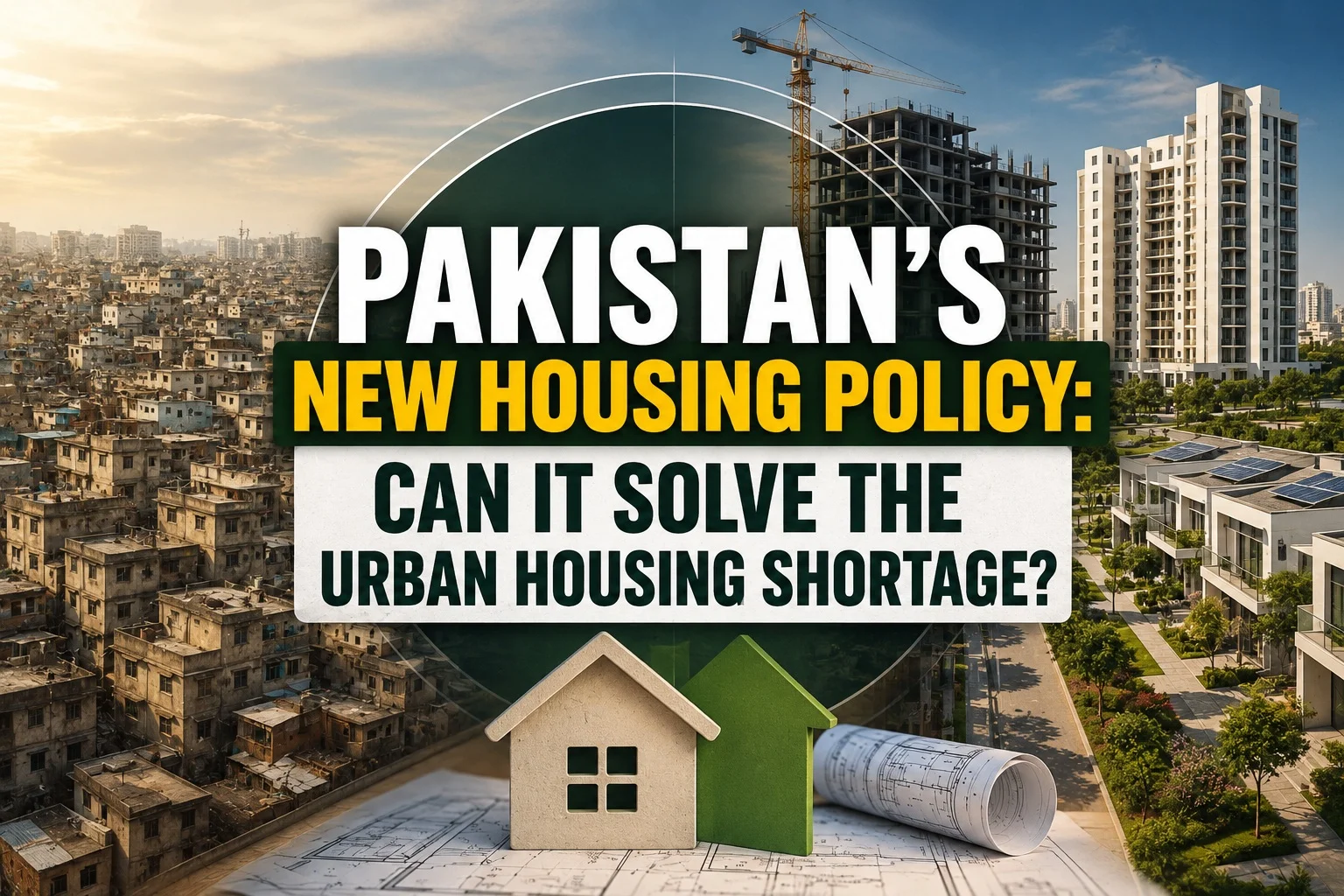
Pakistan’s housing sector has reached a critical point as rapid urbanization, rising construction costs, limited land availability and weak access to housing finance continue to make homeownership difficult for many families. Against this backdrop, the National Housing Policy 2026 has emerged as an important step toward addressing the country’s housing deficit and improving urban development.
The Federal Cabinet approved the policy, nearly 25 years after the previous national housing policy was approved in 2001. The new framework aims to promote adequate, affordable and sustainable housing while improving access to basic amenities and supporting infrastructure.
But an important question remains: Can Pakistan’s new housing policy actually solve the urban housing shortage?
Why Does Pakistan Face a Housing Shortage?
Pakistan’s housing shortage is closely linked to population growth and rapid urbanization. As more people move toward major cities in search of employment, education and better services, demand for residential properties continues to increase.
The State Bank of Pakistan estimates a shortage of around 10 million residential units, with much of the gap affecting low- and middle-income households.
At the same time, formal housing supply has struggled to keep pace with demand. Expensive land, construction materials, infrastructure costs and limited access to affordable financing can make it difficult for households to purchase or build suitable homes.
Urban expansion also creates another challenge. When cities continue spreading outward, housing development can increase pressure on infrastructure, roads and public services. This makes efficient land use and better urban planning increasingly important.
What Does the National Housing Policy 2026 Propose?
The National Housing Policy 2026 provides a broad framework rather than focusing on a single housing scheme. According to the federal government, it covers nine strategic areas, including land for housing, housing finance, construction services, technology and building materials, affordable housing, low-income housing, rural housing, development of secondary towns, and informal settlements such as katchi abadis.
This wider approach is significant because Pakistan’s housing crisis cannot be solved simply by constructing more houses. New homes also need access to roads, water, sanitation, electricity, transport and other essential services.
The policy therefore seeks to connect housing development with broader urban and infrastructure planning.
Can Vertical Housing Reduce Urban Housing Pressure?
One of the most notable features of the new policy is its emphasis on vertical development. Instead of relying heavily on horizontal expansion, cities can accommodate more residents through apartments and other higher-density developments.
This approach could help cities use scarce urban land more efficiently. It may also bring homes closer to employment centres, public transport and essential services when supported by appropriate planning.
Vertical housing, however, is not automatically affordable. Apartment prices can remain high if land, construction and financing costs continue rising. High-density developments also require reliable infrastructure and careful planning to avoid congestion and pressure on utilities.
Therefore, vertical housing can become part of the solution, but it needs to be combined with affordable housing policies, efficient planning and adequate infrastructure.
Housing Finance Could Improve Affordability

Access to housing finance is another important part of solving Pakistan’s housing shortage. Even when suitable properties are available, many households cannot purchase them because they lack sufficient savings or affordable long-term financing.
The State Bank of Pakistan revised the affordable housing finance scheme in March 2026. The revised framework allows financing of up to PKR 10 million, with a fixed customer rate of 5%. It covers houses of up to 10 marla or 2,720 square feet and flats of up to 1,500 square feet.
The Wazir-e-Azam Apna Ghar Program – Ghar Ho Tu Apna has also received implementation-related facilitation, including a requirement that banks and HBFCL complete the credit approval process within 15 working days when a complete application is received.
These measures can make home financing more accessible, particularly for first-time buyers. However, affordability ultimately depends on household incomes, property prices, interest rates and the availability of suitable homes.
What About Low-Income Families?
A major test of the new housing policy will be whether it benefits households that are most affected by the housing shortage.
Low-income families may struggle to qualify for conventional mortgages even when subsidized financing is available. They may also be priced out of formal housing because of high land and construction costs.
The policy’s focus on affordable, low-income and low-cost housing is therefore important. Expanding housing supply for lower-income households could help reduce overcrowding and dependence on informal settlements.
However, implementation will matter more than policy statements. Affordable housing projects need suitable land, transparent eligibility criteria, reliable infrastructure and financing mechanisms that match the financial capacity of lower-income households.
Key Challenges to Implementation
The biggest question is not whether Pakistan needs a new housing policy it clearly does but whether the policy can be implemented effectively.
Several challenges could slow progress. These include expensive urban land, rising construction costs, lengthy approval processes, limited housing finance, weak coordination between institutions and uneven development across cities.
Another challenge is ensuring that housing growth is supported by infrastructure. Building large numbers of residential units without adequate roads, public transport, water, sanitation and electricity could simply shift the problem from housing shortage to infrastructure pressure.
Coordination between federal, provincial and local governments will therefore be essential. Private developers and financial institutions will also have an important role in increasing housing supply.
Can Pakistan’s New Housing Policy Solve the Housing Shortage?
The National Housing Policy 2026 has the potential to make a meaningful contribution to Pakistan’s housing crisis, but it is unlikely to solve the shortage on its own.
Its strengths are its broad scope and focus on several major issues at the same time: land availability, housing finance, affordable housing, construction technology, urban development and informal settlements.
The emphasis on vertical development could help address limited urban land. While improved housing finance could make homeownership more achievable for some families.
However, the success of the policy will depend on implementation. Pakistan needs a sustained increase in housing supply, better urban planning, accessible financing and infrastructure investment. The government must also ensure that affordable housing reaches the people who need it most rather than becoming concentrated in higher-value developments.
Frequently Asked Questions (FAQs)
1. What is Pakistan’s new housing policy?
Pakistan’s new housing policy provides a national framework to increase affordable housing, improve housing finance, promote vertical development and address the country’s housing shortage.
2. What is the National Housing Policy 2026 in Pakistan?
The National Housing Policy 2026 focuses on affordable and low-income housing, housing finance, efficient land use, urban development, infrastructure and informal settlements.
3. Can Pakistan’s new housing policy solve the urban housing shortage?
The policy could help reduce Pakistan’s urban housing shortage by increasing housing supply, improving financing and encouraging vertical development, but successful implementation will be essential.
4. How can vertical housing help reduce Pakistan’s housing shortage?
Vertical housing can accommodate more people on limited urban land, potentially increasing housing supply while reducing pressure for cities to expand outward.
5. How will the new housing policy improve affordable housing in Pakistan?
The policy aims to improve access to affordable housing through better housing finance, low-income housing initiatives, efficient land use and increased residential development.
Conclusion
Pakistan’s new housing policy represents an important shift toward a more coordinated approach to housing and urban development. After nearly 25 years without an updated national framework, the National Housing Policy 2026 provides a strategic direction for tackling the country’s housing deficit.
It could help improve housing affordability and urban land use through vertical development, expanded housing finance and greater attention to low-income housing.
Still, a policy document alone cannot eliminate Pakistan’s urban housing shortage. Its real impact will depend on how quickly and consistently its proposals are translated into housing projects, financing opportunities, infrastructure and effective urban planning.
In short, Pakistan’s new housing policy can be part of the solution. But its success will ultimately be measured by the number of affordable, well-planned homes actually delivered to families across the country.
Want to know more? Check out National Housing Policy 2026: Can Vertical Housing Make Homes Affordable?
Like, share and comment: Facebook, Instagram, Youtube and TikTok.




Join The Discussion