
Buying a plot or house in a housing society is a major financial decision. Before paying a booking amount or signing an agreement, buyers should verify that the housing society has a legitimate claim over the land and that the property can legally be sold or transferred.
Verifying housing society land ownership before buying property can help buyers identify ownership disputes, incomplete documentation, unauthorized developments, and other legal risks. It also provides greater confidence that the plot or property they are purchasing is backed by valid land records and approvals.
Here is a practical step-by-step guide to checking land ownership and legal status before investing.
Why Is Housing Society Land Ownership Verification Important?
A housing society may advertise attractive plots, payment plans, and development facilities, but marketing material alone does not establish legal ownership.
Land ownership verification helps determine:
- Who legally owns the land
- Whether the society has acquired the land lawfully
- Whether ownership documents are genuine
- Whether the land is subject to a dispute or mortgage
- Whether the housing scheme has the required approvals
- Whether the advertised plot falls within the approved area
Skipping these checks can expose buyers to financial losses and lengthy legal disputes.
1. Ask the Society for Land Ownership Documents
The first step is to request copies of the documents showing how the housing society acquired the land.
Depending on the project and location, these may include registered sale deeds, transfer documents, allotment records, land acquisition documents, and other ownership evidence.
Do not rely solely on a brochure, booking form, or statement from a sales representative. Ask to see the original documents or properly certified copies where possible.
You should also compare the land described in the ownership documents with the land covered by the housing scheme.
2. Verify the Land Record Through the Relevant Authority
After obtaining the documents, verify the ownership record through the appropriate land-record authority.
For properties in Punjab, buyers can use the Punjab Land Records Authority (PLRA) system and relevant Arazi Record Centres for land-record verification.
Depending on the property, records may provide information about ownership, land particulars, mutations, and other relevant details.
The information in the official record should be consistent with the documents provided by the housing society.
If the names, land area, ownership shares, or other important details do not match, stop the transaction until the discrepancy is properly explained.
3. Check the Fard and Ownership Details
A Fard is an important land-record document used to establish information about land ownership and related particulars.
When reviewing a Fard, buyers should carefully check:
- Owner’s name
- Khewat and Khatuni details where applicable
- Khasra numbers
- Total land area
- Ownership shares
- Relevant mutations or Intiqal
- Any apparent restrictions or discrepancies
The exact records and terminology can vary according to the property and jurisdiction. Therefore, buyers should obtain the latest available record rather than relying on an old document supplied by a seller.
4. Verify Mutation or Intiqal Records
An Intiqal, commonly referred to as mutation, records a change in rights or ownership in the land record.
If the housing society claims that land was purchased or transferred to it, the relevant ownership transfer should be properly reflected in official records where applicable.
Buyers should compare the mutation information with the sale deed and other ownership documents.
If a society claims ownership but the official land record still shows another owner, this is a major warning sign that requires professional verification before proceeding.
5. Check the Housing Society’s NOC and Approval Status
Land ownership is only one part of property due diligence. A society may have access to land but still lack the necessary approval to develop or market a housing scheme.
Check the society’s No Objection Certificate (NOC) and development approval with the relevant development authority.
The responsible authority depends on the location. For example, buyers in Faisalabad may need to verify the project’s status with the Faisalabad Development Authority (FDA), while different authorities apply in other cities.
Do not assume that an NOC for one phase automatically covers every phase, block, or extension of a housing society.
Verify that the specific land and block being marketed are included in the approved scheme.
6. Compare the Approved Layout Plan With the Land
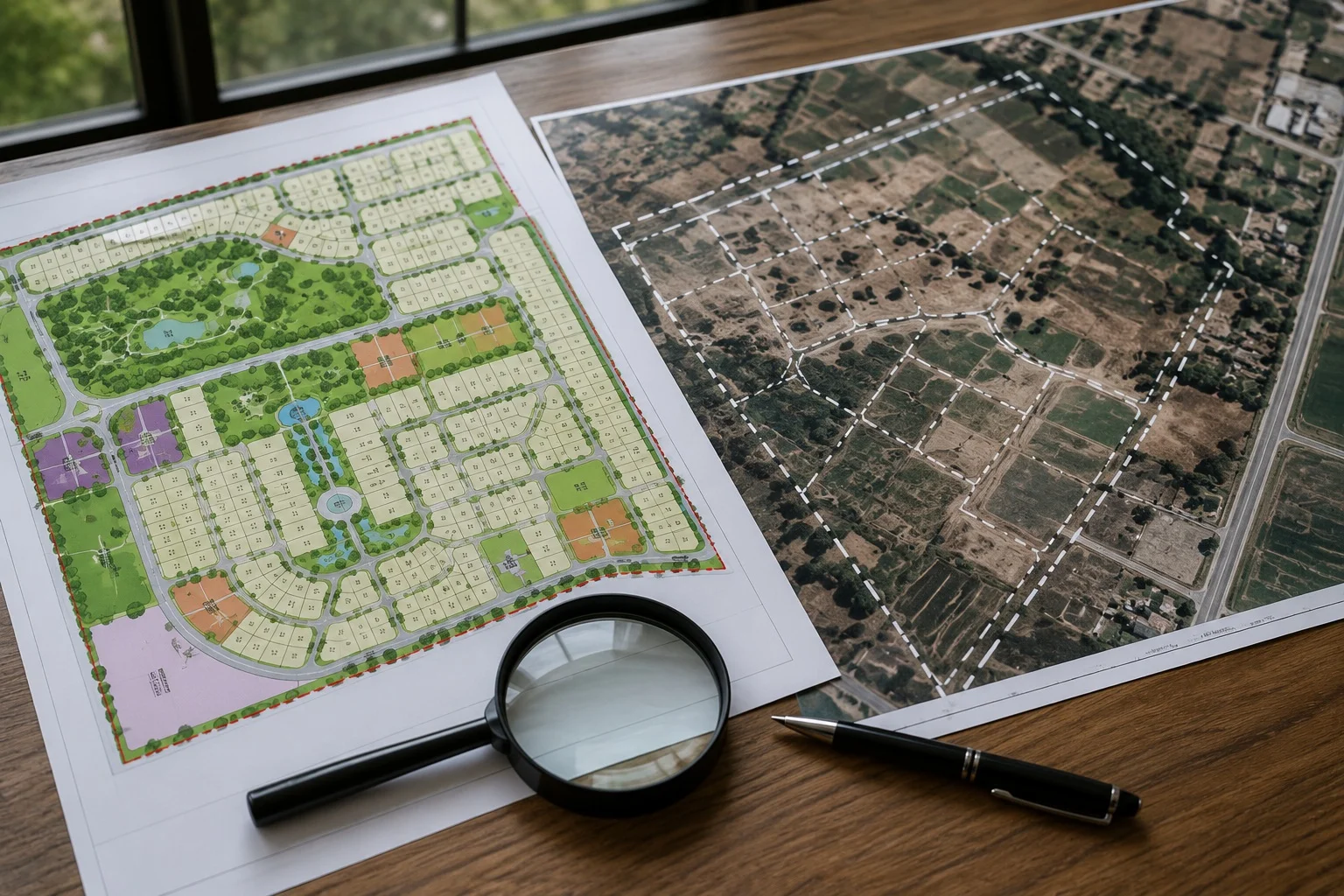
A housing society’s approved layout plan can provide important information about the project’s boundaries and planned land use.
Compare the approved plan with the society’s current map and marketing material.
Pay attention to:
- Society boundaries
- Plot numbers
- Roads
- Parks
- Commercial areas
- Public utility areas
- Open spaces
- Amenity plots
- Block boundaries
This step can help identify situations where a property is being marketed in an area that is not part of the approved scheme.
7. Check for Disputes, Mortgages, or Encumbrances
Before purchasing, buyers should determine whether the land is involved in litigation or subject to a mortgage, charge, acquisition issue, or other legal restriction.
A clean title is important because ownership alone does not always mean that the property is free from legal complications.
Ask the society or seller for relevant information and, where necessary, have a property lawyer conduct a legal search.
If there is an unresolved ownership dispute, court case, mortgage, or conflicting claim, avoid making a substantial payment until the issue has been independently verified and resolved.
8. Verify the Plot’s Connection to the Society-Owned Land
Even if a housing society owns land, the specific plot you want to purchase must also be properly identifiable.
Check the plot number, block, dimensions, location, and status against the approved layout plan and society records.
For a resale property, compare the seller’s ownership or allotment documents with the society’s transfer record.
This is particularly important when buying a plot through a dealer or existing allottee rather than directly from the developer.
9. Don’t Rely on Verbal Assurances
Statements such as “the NOC is coming,” “the land is completely clear,” or “approval will be issued soon” should not replace official verification.
Similarly, attractive discounts or urgent payment deadlines should not pressure you into skipping due diligence.
A genuine property transaction should allow sufficient time to review ownership documents, approvals, and transfer records.
10. Get Legal Verification Before Making a Large Payment
Property documentation can be complicated, especially when land has changed hands multiple times or a large housing scheme consists of different land parcels.
If you are making a significant investment, consult a qualified property lawyer or experienced land-record professional.
Ask them to review the title documents, land records, mutation history, approvals, and relevant agreements.
Professional verification can cost much less than dealing with a disputed or illegally marketed property later.
Housing Society Land Ownership Verification Checklist

Before buying property in a housing society, make sure you have checked:
- Society’s land ownership documents
- Latest available land record
- Fard or relevant ownership record
- Mutation/Intiqal where applicable
- Registered title documents
- Housing society NOC
- Development authority approval
- Approved layout plan
- Plot number and dimensions
- Land boundaries
- Ownership or allotment record
- Possible disputes or encumbrances
- Seller’s identity and authority to sell
Frequently Asked Questions (FAQs)
1. How can I verify housing society land ownership before buying property?
To verify housing society land ownership, check the society’s registered ownership documents, latest land records, Fard, mutation or Intiqal records, and relevant title documents. Cross-check the information with the appropriate government authority before making a payment.
2. What documents should I check before buying property in a housing society?
Check the land ownership documents, Fard or relevant land record, registered title deed, mutation or Intiqal, housing society NOC, approved layout plan, development authority approval, and the property’s allotment or transfer documents.
3. How can I check land records before buying a property?
You can check available land records through the relevant provincial land-record authority or record centre. Compare the recorded owner’s name, land area, Khasra details, and other ownership information with the documents provided by the housing society or seller.
4. Is an NOC enough to verify housing society land ownership?
No. An NOC confirms that a housing scheme has received a particular regulatory approval, but it does not by itself establish complete ownership of the land. Buyers should separately verify title and land ownership records.
5. What is the role of Fard in property ownership verification?
Fard provides important information about land ownership and related particulars. Buyers can use it to compare the owner’s name and land details with the society’s title documents and other official records.
6. What are the red flags when checking housing society land ownership?
Important red flags include missing ownership documents, differences between official records and society documents, disputed land, unclear NOC status, land outside the approved layout, unexplained ownership transfers, and pressure to make an immediate payment.
7. Should I hire a property lawyer before buying a plot in a housing society?
For a high-value purchase or complicated ownership history, consulting a qualified property lawyer is advisable. A lawyer can review title documents, land records, approvals, transfer documents, and potential legal disputes before you invest.
Conclusion
Verifying housing society land ownership before buying property should be one of the first steps in your property-buying process, not something done after making a payment.
Start by checking the society’s ownership documents, confirm the land record through the relevant authority, review Fard and mutation information where applicable, and verify the project’s NOC and approved layout plan. For a high-value purchase, independent legal verification is also advisable.
A low price or attractive payment plan should never outweigh legal certainty. Taking time to verify ownership and approvals can help buyers make a safer and more informed property investment.
Want to know more? Check out How to Choose the Best Housing Society for Your Family in Pakistan.
Like, share and comment: Facebook, Instagram, Youtube and TikTok.


Join The Discussion