
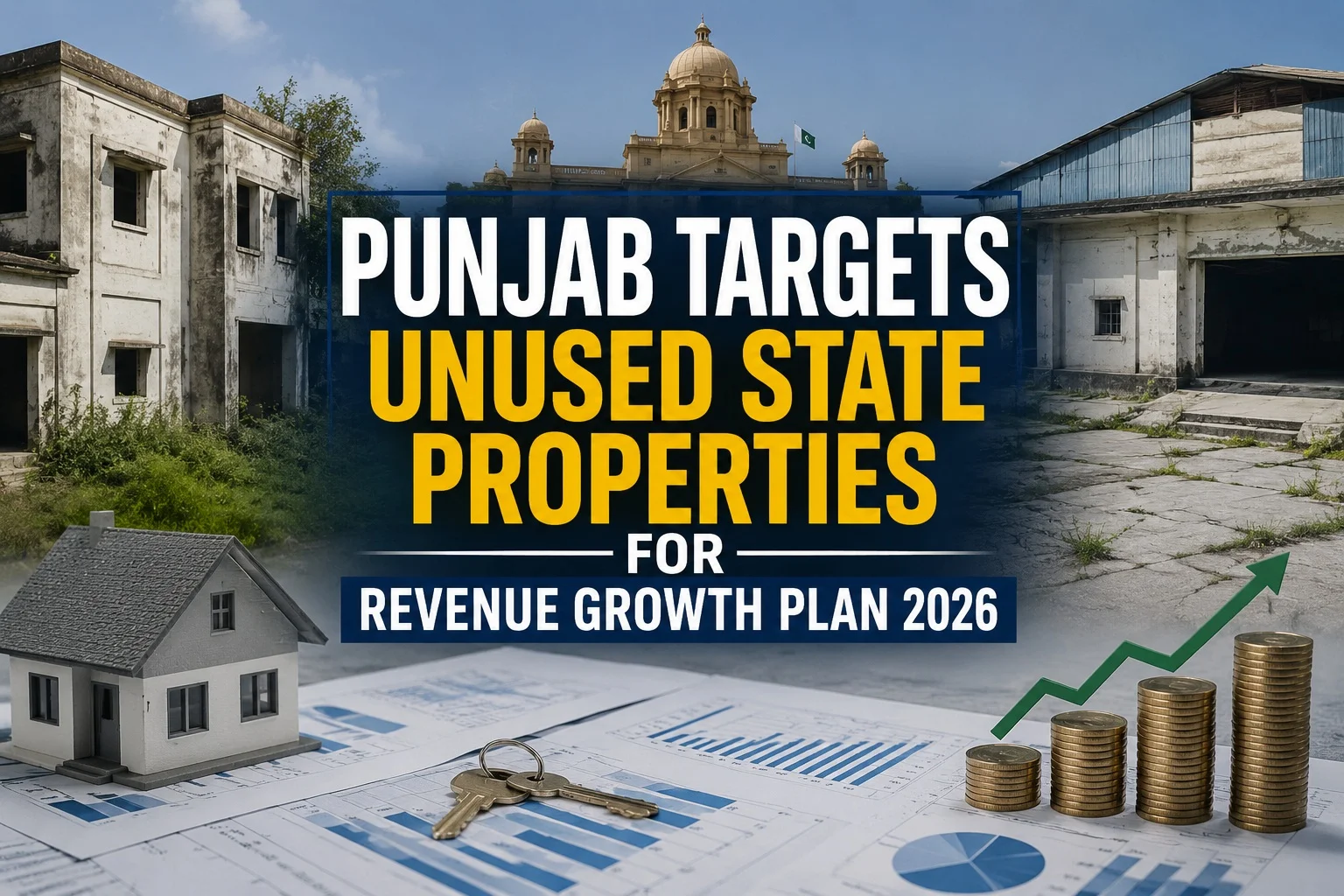
The Punjab government has launched a major policy direction for 2026 aimed at improving fiscal stability and strengthening provincial revenue collection through better management of public assets under the Punjab Targets Unused State Properties for Revenue Growth Plan 2026. A key focus of this initiative is the identification and utilization of unused and underutilized state properties across Punjab, including government land, vacant buildings, and idle public infrastructure.
This move reflects a broader shift toward data-driven governance, where Punjab unused state properties are being treated as strategic financial assets rather than inactive holdings. With rising fiscal demands and increasing pressure to expand non-tax revenue sources, Punjab’s administration is prioritizing a structured approach to map, assess, and monetize state-owned properties in Punjab.
The initiative is expected to significantly impact urban development, public asset management, and the real estate sector in Punjab.
A Shift Toward Efficient Asset Management
Traditionally, many government-owned properties in Punjab have remained idle due to incomplete records, weak inter-department coordination, and administrative delays. These include unused residential units, abandoned commercial buildings, and large tracts of undeveloped government land assets in Punjab.
Under the 2026 revenue growth plan, authorities are working to compile a centralized database of unused state properties in Punjab. This effort involves coordination between housing departments, development authorities, and land record institutions to ensure a complete and updated inventory.
The goal is to create a transparent system for public property utilization in Punjab, where every asset is tracked, evaluated, and categorized based on its economic potential.
Digital Mapping and Data Collection Strategy

A major component of the Punjab initiative is the use of modern technology for identifying unused assets. Authorities are increasingly relying on digital land records systems, GIS mapping, and satellite imaging to detect vacant or underutilized government properties.
By integrating land registry data with utility usage patterns and physical verification reports, the government aims to accurately identify vacant state-owned properties in Punjab that are officially recorded but not actively used.
This digital transformation is expected to improve transparency, reduce errors in land documentation, and support long-term improvements in land asset management and urban planning systems.
Revenue Generation Through Property Utilization
The core objective of targeting Punjab unused state properties is to increase provincial revenue without introducing excessive new taxes. Instead, the government is focusing on asset monetization of public properties as a sustainable financial strategy.
Once identified, these properties may be utilized through several channels:
- Leasing government assets to private investors under regulated agreements
- Developing public–private partnerships (PPP) for commercial projects
- Auctioning selected state-owned land parcels
- Converting idle buildings into productive public or commercial facilities
This strategy supports the broader Punjab revenue growth plan 2026, which emphasizes maximizing returns from existing assets rather than relying only on traditional taxation systems.
Officials believe that better utilization of idle government land can improve financial efficiency while also supporting economic activity in construction, housing, and real estate development sectors.
Impact on Real Estate and Urban Development
The identification and activation of unused government properties in Punjab is expected to reshape the provincial real estate landscape. Major urban centers such as Lahore, Faisalabad, Rawalpindi, and Multan may experience increased development activity as idle public land is integrated into formal development frameworks.
For the private sector, this initiative opens new opportunities for investment through leasing models and development partnerships. It may also improve transparency in land availability and reduce speculative holding of undeveloped state-owned properties in Punjab.
However, experts suggest that increased supply of government land entering the market may temporarily affect pricing dynamics in some regions.
In the long term, improved utilization of public assets is expected to support housing supply growth, infrastructure expansion, and stronger urban property tax systems.
Strengthening Transparency and Governance
Another key objective of this initiative is improving governance in land administration. In the past, fragmented data systems and outdated records have created inefficiencies in managing government property assets in Punjab.
By implementing a centralized digital framework, the government aims to reduce duplication of records and improve coordination among departments responsible for land management.
This system will also help prevent unauthorized occupation and misuse of state land, a long-standing issue in certain urban and peri-urban areas.
Overall, the reform strengthens accountability and supports better enforcement of property regulations across Punjab.
Economic and Fiscal Implications
From a fiscal perspective, the Punjab revenue growth plan 2026 aims to expand non-tax revenue sources. It does this by unlocking the value of existing public assets.
Economists suggest that efficient use of idle government properties in Punjab could help stabilize provincial finances. It can generate sustainable income through leasing, partnerships, and asset development.
In addition, this initiative may create new employment opportunities in construction, property management, and urban development sectors. It also encourages private sector participation in infrastructure projects through structured investment models.
Challenges in Implementation
Despite its potential benefits, the initiative faces several challenges. One of the key issues is the accuracy and completeness of existing land records in Punjab, which may require extensive verification and updates.
Coordination between multiple departments is another major challenge, especially in large cities where jurisdictional overlap exists.
Additionally, resistance to structural reforms and informal land use practices may slow down implementation in certain regions.
Conclusion
The Punjab Targets Unused State Properties for Revenue Growth Plan 2026 marks a significant shift in how the province manages its public assets. The government is now focusing on unused state properties in Punjab. This initiative aims to improve fiscal stability. It does so through better asset utilization, digital land records, and transparent property management systems.
This initiative highlights a broader shift toward modern governance. In this approach, state-owned properties in Punjab are no longer seen as inactive assets. Instead, they are treated as key contributors to economic growth and revenue generation. Through improved tracking, data collection, and structured planning. Punjab intends to enhance efficiency in public property utilization and land asset management.
If implemented effectively, this strategy could strengthen provincial finances. It may also support urban development across Punjab. In addition, it can create a more transparent real estate framework. Overall, the plan reflects a long-term effort. It aims to convert idle government land and properties into productive economic resources. This supports sustainable growth in 2026 and beyond.
Want to know more? Check out How the New LHC Property Rights Protection Mechanism Benefits Property Owners in Punjab
Like, share and comment: Facebook, Instagram, Youtube and TikTok.




Join The Discussion